
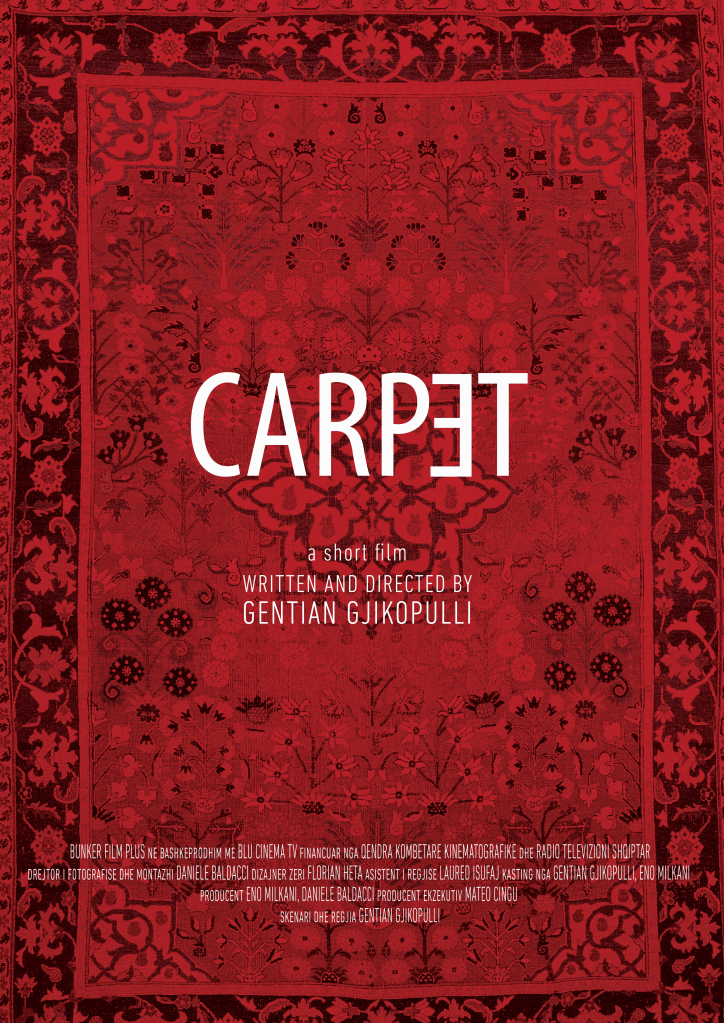
Logline
When the father of three immigrant brothers dies, and the price of transporting his body beyond the border is unbearable, a dreadful and genius idea fulfills his last will.
Synopsis
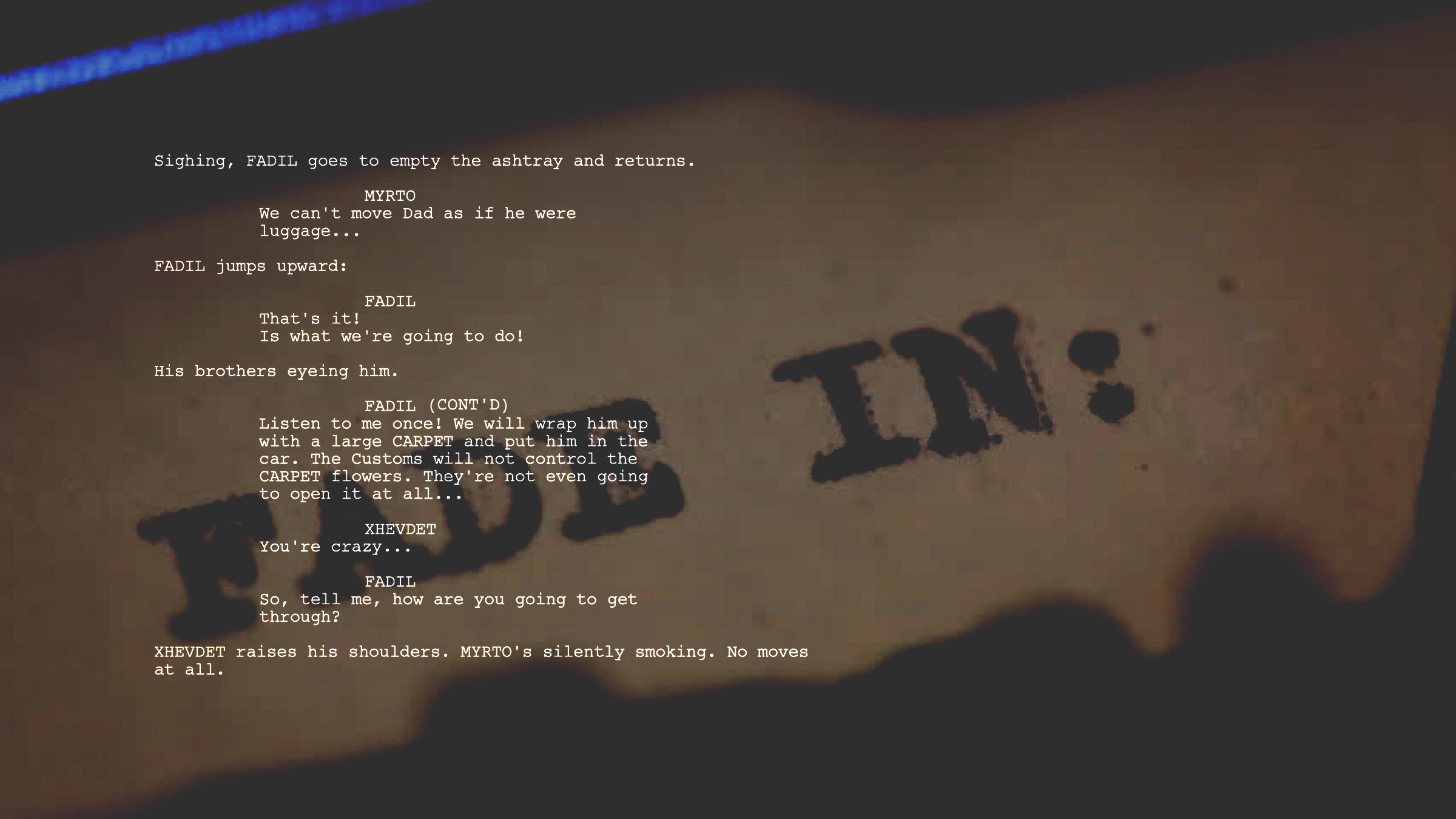
Based on an actual event, “CARPET” is the story of three immigrant brothers in Greece and their father, who passed away on foreign soil. The boys want to fulfill his last wish, returning his body to their homeland, Albania. From the conversation with the Greek funeral employee, despite his kindness, it seems impossible to realize their father’s will, as the price of transport across the border is extremely high and unbearable for them. They fall into despair, but an idea as dreadful as well as genius of the younger brother gives them hope. They will transport THE BODY across the border as purchased goods, rolled up in a giant CARPET, tied over the car. In this way, they will avoid many questions, suspicions, investigations, and allegations of corpse transport. They decide, buy THE CARPET, get ready and depart, nervous about what might happen at the border.
They approach and wait for their turn in the Greek Customs. The tension increases with the start of the car’s physical control. A police officer doubts when he notices the anxiety of the three brothers. Under the strict control of the Greek Border Police, dealing with much difficulties, they pass across their “merch” to the Albanian Border Police. After a routine check, they are allowed to enter their homeland. Freed from the cross-border’s anxiety, they decide to stop for lunch, near a restaurant by the side of the road. The table is full of dishes and brandies. Once finished, they get up, pay, and go to the parking lot. There awaits an unpleasant surprise.
THE CARPET WITH THE BODY INSIDE HAVE DISAPPEARED, STOLEN.
They do not believe their eyes. So, they ask the passers-by, the gardener, a couple sitting by the window at the restaurant where they had lunch. Nothing. Sitting at a restaurant’s table, they’re totally exhausted. Suddenly, the door opens, and a RASCAL type gets in, reaching their table. He threatens to denounce them for a dead body illegal transport across the border. He claims for a bribe to return the “merch” wrapped in THE CARPET. Then, he leaves a phone number and gets out. Sleepless, at dawn, the brothers decide to pay. They make the call, leave the envelope with their last Euros at the Reception Desk, leaving to get the “merch” back. The entire city is decorated with red flags for the Albania’s Independence Day. They pass over a completely empty square, except for a police patrol that stares at them suspiciously.
According to the instructions received, they reach “The Independence Park”, where, on a bench, they find their father’s BODY, this time wrapped in a large, red Albanian flag.
Director Statement
In 45 years of communism, we’re used to hearing actual stories of escapes, from the simplest to the most fantastic. A bunch of them successfully accomplished while others… Pushed by the tremendous pressure of that regime, people were forced to make genius inventions to achieve the goal. That’s what distinguished them. It applies to those who escaped swimming on the Lake Ohrid, with empty watermelons on their heads, or some years later, to those who placed the cart and cabin of a truck over large barrels, thus inventing a kind of motorized raft, saluted, with respect from the Italian “Guardia di Finanza”.
Based on actual events and similar to the above stories in terms of genius, CARPET is the only local story I’ve heard where the action is the other way around. It’s a story about a smuggling return to the homeland instead of an unauthorized escape. It is not about the hopeful dream of a living but the last will of a transported corpse. This makes it a painful story with some absurd notes on it. But this makes it a story worth telling. The conventional stereotype according to which the foreign land remains alien, when the return to the homeland is a coming back to the comfort zone, permeates the whole narrative of CARPET. These general perceptions constantly nurture “patriotism” and have their variations in every country of the world. This perspective accompanies us throughout the story of CARPET until the climax turns over everything. That turning point wipes out the facade, the surface, bringing out the truth without patriotic pathologies. It is the culmination of this human event.
For this reason, we will hold the Greece scenes under a light gray monochrome filter, winter shot, in a gloomy and sunless time. In this way, in the first part, we amplify the feeling of anxiety and fear of the unknown that may occur while crossing the border. But most of all, this attitude emphasizes the perception and illusion that after overcoming the obstacle, everything will go fine. For the same reason, the moment of the journey and the cross-borders will be like a transition from one state to the other. Early morning on Greek soil to the border – under the grey nuance with desaturated image – and then on the Albanian land – full of sunlight, stimulating optimism. Unlike the Greek part, the Albanian scenes will be full of color until when the CARPET with the BODY is stolen, when we’re back again to dull colors. We follow with the last image when the first ray of sunshine illuminates the BODY wrapped in a red flag under the gray veil of the morning.
The characters will be as realistic as possible without overacting or exaggerating gestures. We will pay special attention to THE RASCAL character, the key character that turns over the audience’s expectations. Therefore, we will sculpt him as the most distinguished character to remember. There will be no music throughout the film to maintain the focus only on the narrative and psychology of the characters. This choice also helps the sound design be progressive throughout the storyline – in the Greek scenes, the sound will be reserved, relatively low. In contrast, it will be louder, more dynamic, and messier in the Albanian settings. Our point will be to remember more the events, without leaving aside the characters or crucial details such as the Independence Day Albanian city scene or the BODY wrapped in a red flag. Thus, the audience will take away that bitter taste from this absurd story, reflecting on the system of society’s values.
CARPET is a journey, an Albanian drama with an absurd light veil, aiming to deliver powerful messages resonating to a broad international public.
Technical Specifications
Project Title (Original Language): TAPET
Project Type: Narrative, Short
Genres: Drama
Status: Second Draft / In Development
Registered: SWN – Screenwriters Network, Copyright Office – Albania
Approximate Runtime: 35 minutes
Country of Origin: Albania
Country of Filming: Albania, Greece
Language: Albanian, Greek
Shooting Format: 4K Digital
Aspect Ratio: 16:9
Film Color: Color
 gentiangjikopulli.com