
Logline
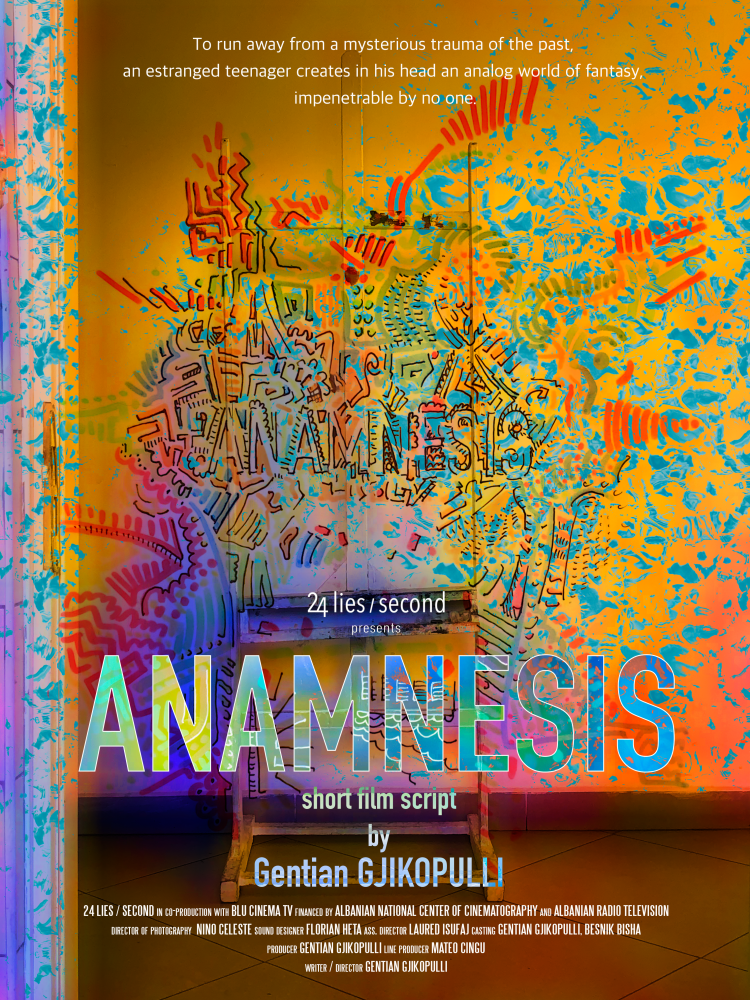
To run away from a mysterious trauma of the past, an estranged teenager creates in his head an analog world of fantasy, impenetrable by no one.
Synopsis
The story takes place nowadays, in an artistic high school where everyday life changes completely when a student, ARISTIDH, brings among friends the youngest member of the group – a white RABBIT. Since keeping animals in the Dormitory is not allowed, ARISTIDH with his close friends, JORGJI and MUSA, do what they can to hide him, and to create him good conditions. They modify a painting wooden case by turning it into a portable bed. They feed him carrots and cabbages from the Refectory. During the lectures and study hours, they hold him in a slightly open sports bag. Often he breaks free, running between benches, in the yard, and at the Refectory.
One day, a strange game begins where the guys throw to THE RABBIT pieces of carrot, salad sheets and bread knobs. He runs and catches them all. The boys simper and then make fun of FASLLI, who always misses the mark. The latter secretly gets a small stone.
He throws it to THE RABBIT.
The stone hits him in the head. THE RABBIT breaks down.
The boys freeze. They’re short of breath.
THE RABBIT dies.
The boys turn to FASLLI, but he’s long gone.
The boys gather around ARISTIDH, who holds the dead RABBIT in his arms.
They decide to make him a magnificent funeral.
They distribute Obituary Announcements across classes, stick them on school’s walls, disperse them into the air. At the exact time, in front of the Dormitory door, a large crowd is gathered, as well as a Brass Band. ARISTIDH, the little coffin in his hands, followed by the solemn procession, moves slowly towards the corner of the yard under the tunes of Chopin’s “Funeral March,” played by the Brass Band. They reach an open pit where ARISTIDH reads a pompous speech full of deeds of the deceased. Then, he holds the condolences visit at the large Refectory’s hall. His friends approach and sit down in a row, throwing cigarettes in front of his lap. They smoke. A dense fog covers the Refectory. Suddenly someone shouts:
“The Director!”
A mess. Everyone runs and disappears. The benches and chairs fall on the ground. ARISTIDH freezes. A flashlight circle crosses from one corner of the Refectory to the other. The strong light moves left to right in our direction, then disappears, revealing us…
Two DOCTORS with stethoscopes, and a NURSE, folder and pen in hand, watch us, keeping records. There’s no more Refectory, students or teachers. The DOCTORS discuss, concluding that THE PATIENT suffers a strong and mysterious trauma from the past. He has created in his mind a parallel, more acceptable and less painful reality. According to them, he, ARISTIDH, is an already prey to his own fantasy from where he cannot come out, nor he won’t come out.
Motionless as a statue in his velvet jacket, with his half-open feet and frozen smile, ARISTIDH waves his eyesight into the void.
Director Statement
ANAMNESIS is the result or influence of two major inspirations; the first relates to my approach to psychology and the craving to understand the human behavior; the second relates to a real episode of my father’s school years. The event in question stands apart from everything else by the lyrical, and pure dream-like touch of the whole narrative, which in its structure allows in a certain extent the surrealism. Meanwhile, the other storyline, more terrestrial, brutal and harsh, intermingles with the former, interfering in this story with its clinical realism. Both lines create a symbiosis that we can interpret as the relationship between fiction and non-fiction, fabrication and truth.
Reality is a matter of perception.
Thus, we conceive the “imagined” part to be hyperbolic, with the intervention of some surreal elements, injected in the scenes or in the overall setting. The dream-like vision, with vivid colors, natural lighting, paper sketches waving in the air, and unusual characters, is paramount. The scene settings will be messy, full of energy and life. It will be given priority to scenography, costumes and props, to create an electrifying and “subjective” atmosphere of the event. In contrast to this approach, is the part of the Doctors. Under an indoor and non-natural lighting, in pale pastel colors and with a minimal blocking of actors, the scene will be the “coming to terms” of the film’s narrative arch and the “objective” truth of the event.
Thus, as a conclusion, ANAMNESIS is a metaphorical fight between heart and mind, real and surreal, objective and subjective, leaving the audience with a bitter-sweet sensation and the weight of some implied, mysterious trauma.
Technical Specifications
Project Title (Original Language): ANAMNEZA
Project Type: Narrative, Short
Genres: Drama
Status: Second Draft
Registered: Copyright Office – Albania
Approximate Runtime: 25 minutes
Country of Origin: Albania
Country of Filming: Albania
Language: Albanian
Shooting Format: 4K Digital
Aspect Ratio: 16:9
Film Color: Color

 gentiangjikopulli.com